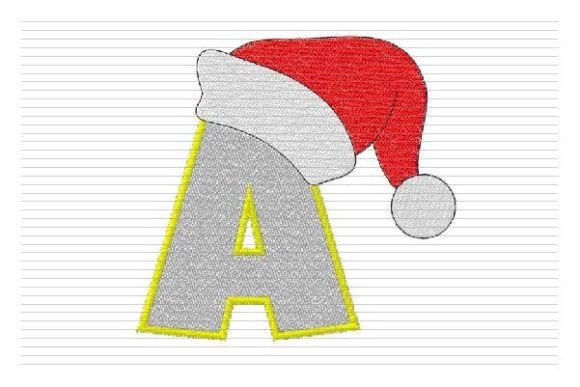
A Letter Christmas Alphabet Santa Hat
First Impressions: Cheerful, Clear, and Instantly Recognizable
Opening A Letter Christmas Alphabet Santa Hat feels like unwrapping a small holiday gift—bright, playful, and full of intent. The letters sit upright and evenly spaced, each crowned with a jaunty Santa hat: red dome, white pom-pom, subtle brim. There’s no clutter, no overwrought detail—just clean outlines and confident proportions. It reads as friendly rather than fussy, nostalgic without leaning into kitsch. This isn’t a design shouting for attention; it’s one that invites personalization, whether you’re stitching a baby’s onesie with their initial or branding a boutique’s holiday tote bag.
Real-World Use: What It Does Best (and Where It Shines)
Last week, I used A Letter Christmas Alphabet Santa Hat to embroider a set of linen tea towels for a local kitchenware shop. We chose “J” for “Joy,” “N” for “Noel,” and “G” for “Gift”—each letter centered on the towel’s lower corner, 3.2 inches tall. The result was cohesive, charming, and unmistakably seasonal. Customers responded immediately—not just to the theme, but to how *legible* and *balanced* each letter felt at that scale. That’s where this embroidery file earns its keep: in projects where clarity matters more than complexity.
It works especially well on medium-weight fabrics—cotton twill for aprons, fleece-backed sweatshirts, sturdy canvas tote bags, and even quilted pillow covers. On a custom embroidered sweatshirt for a preschool holiday show, the “S” and “T” held up beautifully across the chest, with crisp satin-stitched edges and no puckering. For Etsy sellers listing personalized baby blankets, this design gives instant warmth and intention—it signals care, not just decoration.
Where to Proceed Thoughtfully
A Letter Christmas Alphabet Santa Hat is not built for micro-detail work. If you’re planning to stitch it inside a 3-inch hoop on a curved cap or tiny beanie, test first—especially the pom-poms and hat brims. Those small elements rely on stitch density and stabilizer support. On stretchy fabric like jersey knits or thin cotton voile, use cutaway stabilizer underneath and a light tear-away on top. Without it, the hat shapes can distort or lose definition.
Dark fabrics demand attention too. The white pom-poms are likely outlined or filled—but unless the file includes underlay or dense satin coverage, they may read as faint on navy or charcoal. Always run a black-and-white mockup before finalizing thread colors. And if you're layering letters over busy prints or textured weaves (like burlap or terry cloth), consider simplifying placement—centered, isolated, and uncluttered wins every time.
Design Integrity Meets Customer Trust
When customers buy a handmade product, they’re buying your judgment as much as your skill. Using A Letter Christmas Alphabet Santa Hat thoughtfully reinforces that trust. Its consistent spacing and uniform height mean initials line up cleanly on matching sets—think sibling sweatshirts or family aprons. That consistency translates to professionalism, even in small-batch production. For craft fair vendors or boutique owners, it helps maintain brand cohesion across holiday collections without needing custom lettering for every item.
It also elevates perceived value. A plain “M” on a kitchen towel feels generic. An “M” wearing a Santa hat? That’s a story—and stories sell. Buyers recognize the effort behind intentional design, especially when it’s executed cleanly. No one mistakes this for a rushed clipart import.
Practical Designer Notes You’ll Actually Use
- Always test on scrap fabric first—especially with your intended stabilizer combo and thread brand. Satin stitches behave differently across polyester, rayon, and cotton threads.
- Check stitch density before hooping delicate items. Dense fill areas around the hat base may need reduced density or alternate underlay settings for lightweight fabrics.
- Confirm hoop size compatibility. While the full alphabet set likely spans multiple hoops, individual letters should fit comfortably in common 4x4 or 5x7 hoops—verify before prepping client files.
- Inspect small details at 200% zoom: pom-pom shape, hat seam lines, letter interior clearances. These define whether the design feels polished or pixelated.
- Compare light/dark background mockups. Some embroidery files render white elements weakly on dark substrates—adjust thread choice or add outline stitches if needed.
- Use proper stabilizer: medium-cutaway for knits, tear-away for stable wovens, and fusible + tear-away for nap-free surfaces like towels.
- Review licensing before selling finished items or digital products. As a machine embroidery design, its commercial use rights impact your craft business, Etsy listings, and wholesale offerings.
Final Thought: A Reliable Tool, Not Just a Trend
A Letter Christmas Alphabet Santa Hat won’t replace your go-to monogram fonts or custom-drawn motifs—but it fills a specific, recurring need with quiet confidence. It’s the kind of embroidery file you return to year after year because it delivers: no surprises, no stitch-outs, no customer follow-ups asking “Is that supposed to look fuzzy?” It supports your process instead of complicating it. Whether you’re stitching a single personalized gift or producing 50 holiday aprons for a café pop-up, this design holds its ground. It’s cheerful without being cloying, festive without being fleeting—and that’s the mark of a truly useful embroidery asset.