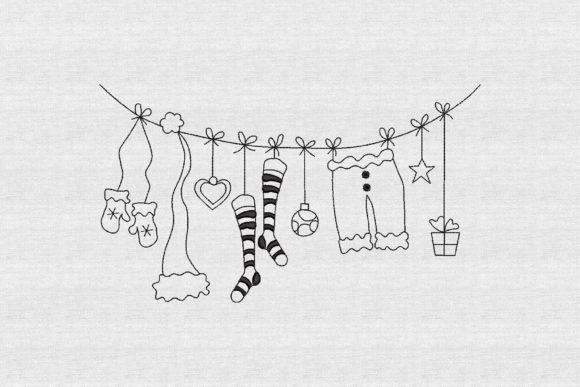
Santa’s Clothesline Sketch Line Art
First Impression: Whimsical, Festive & Instantly Recognizable
As an embroidery designer who’s prepped over 200 craft fair booths—from snowy Vermont markets to sun-drenched California pop-ups—I know what stops a shopper mid-aisle. Santa’s Clothesline Sketch Line Art delivers that split-second hook: it’s playful, gently nostalgic, and undeniably Christmas without leaning into cliché. The “sketch line art” descriptor tells me this isn’t a dense fill design—it’s clean, open, and breathing. That means it reads well at 3 inches on a patch or expands gracefully to 8 inches across a tote bag. It feels farmhouse-fresh but not rustic, modern but not sterile—just right for small shop owners who want charm without clutter.
Where It Shines: Craft Fair Product Realities
This design thrives where handmade authenticity meets holiday warmth. On a natural linen tea towel? Perfect—those loose sketch lines echo hand-drawn charm and won’t compete with texture. As an embroidered patch sewn onto a denim market bag? Yes—its linear simplicity holds up beautifully against stitching and wear. As apron embroidery centered just below the pocket? Absolutely—customers love subtle storytelling, and “Santa’s clothes waiting” invites smiles and conversation. Even on curved surfaces like structured caps, the minimal line work avoids distortion better than heavy satin-stitch faces or tiny bells.
For Etsy sellers and digital embroidery file shops, Santa’s Clothesline Sketch Line Art is a quietly versatile asset. It works as a standalone design for printable mockups (ideal for social media listings), scales cleanly for both small pouches and large pillow covers, and pairs effortlessly with coordinating fonts or simple borders—no extra design lift required. Unlike overly detailed machine embroidery designs that demand premium stabilizers and thread changes, this one favors speed, clarity, and consistency in batch production.
What Buyers Notice—And Why They Reach Out
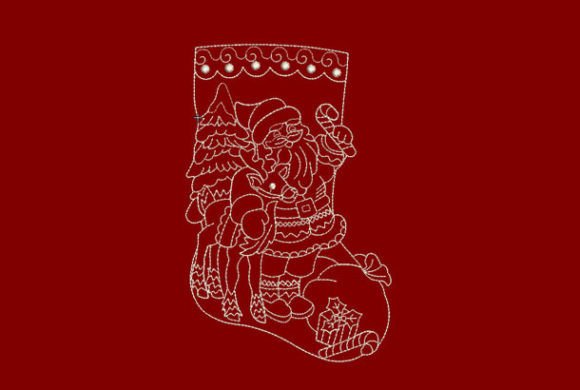
At a craft fair, attention spans are short and tactile engagement is high. Santa’s Clothesline Sketch Line Art wins because it’s legible from six feet away *and* rewards closer inspection—the sock with a curl, the mittens slightly askew, the implied breeze in the line. That duality boosts booth display strength: it draws eyes from the aisle, then encourages customers to pick up the item, feel the stitch quality, and imagine gifting it. Handmade product buyers don’t just buy objects—they buy mood, memory, and intention. This design delivers all three.
It also lifts perceived value. A plain canvas tote becomes a curated holiday piece. A basic cotton apron transforms into a story-driven kitchen essential. And because it’s line art—not cartoonish or overly literal—it maintains brand consistency across diverse products: same design, different contexts, unified voice.
Practical Production Notes Every Embroidery Designer Should Check
- Test before you commit: Run Santa’s Clothesline Sketch Line Art on scrap fabric matching your final product—especially textured tea towels or thick twill caps. Sketch lines can vanish if stitch density is too low or stabilizer too light.
- Thread contrast is non-negotiable: On dark fabric, use bright white or metallic silver thread to preserve line integrity. Avoid blending threads unless intentionally softening the look for boutique aesthetics.
- Hoop size matters: Confirm the design fits your standard hoop without re-hooping mid-stitch—critical when producing 30+ embroidered patches for a weekend fair.
- Stabilizer strategy: Light- to medium-weight cutaway works best for stable fabrics like cotton duck or linen; tear-away suffices for smooth quilting cotton—but skip it for terry cloth or looped towels.
- Create at least one real mockup: Photograph your finished tote bag or apron in natural light. Does the line art pop? Is spacing balanced? Does it look intentional—not accidental?
- Verify commercial licensing: If selling finished products (not just the embroidery file), ensure your license permits commercial embroidery use. Many digital embroidery file sellers restrict resale of physical goods unless explicitly stated.
Careful-Use Considerations for Maximum Clarity
This isn’t a “set and forget” design. Tiny details—like the curve of a hanger or the fold in a stocking—can blur on dense fabrics or at sub-3-inch sizes. Avoid placing it on heavily textured surfaces (e.g., thick waffle-weave towels) without adjusting stitch density or adding underlay. On curved cap fronts, test placement: centering the clothesline mid-crown often reads cleaner than forcing it over the peak. And never assume small lettering (“Who knows what surprises await…”) will translate—many versions omit text entirely for clarity, or convert it to a separate, scalable element.
Final Verdict: A High-Return, Low-Risk Holiday Staple
After 12 years designing for handmade markets, I keep returning to pieces that balance emotional resonance with production practicality—and Santa’s Clothesline Sketch Line Art nails both. It’s festive without being dated, detailed without being fussy, and flexible without feeling generic. For the Etsy seller juggling 15 product SKUs, it’s a reliable anchor design. For the craft fair vendor with limited booth space, it’s a conversation starter that converts browsers into buyers. And for the embroidery business owner scaling holiday collections, it’s a repeatable, licensable, photograph-ready asset that supports both digital and physical sales streams.
If you’re curating your Christmas lineup this season, treat Santa’s Clothesline Sketch Line Art not as just another embroidery file—but as a quiet confidence-builder: the kind of design that makes your booth feel cohesive, your handmade product feel intentional, and your customer feel like they’ve found something special—not seasonal, but story-worthy.